What This Framework Provides
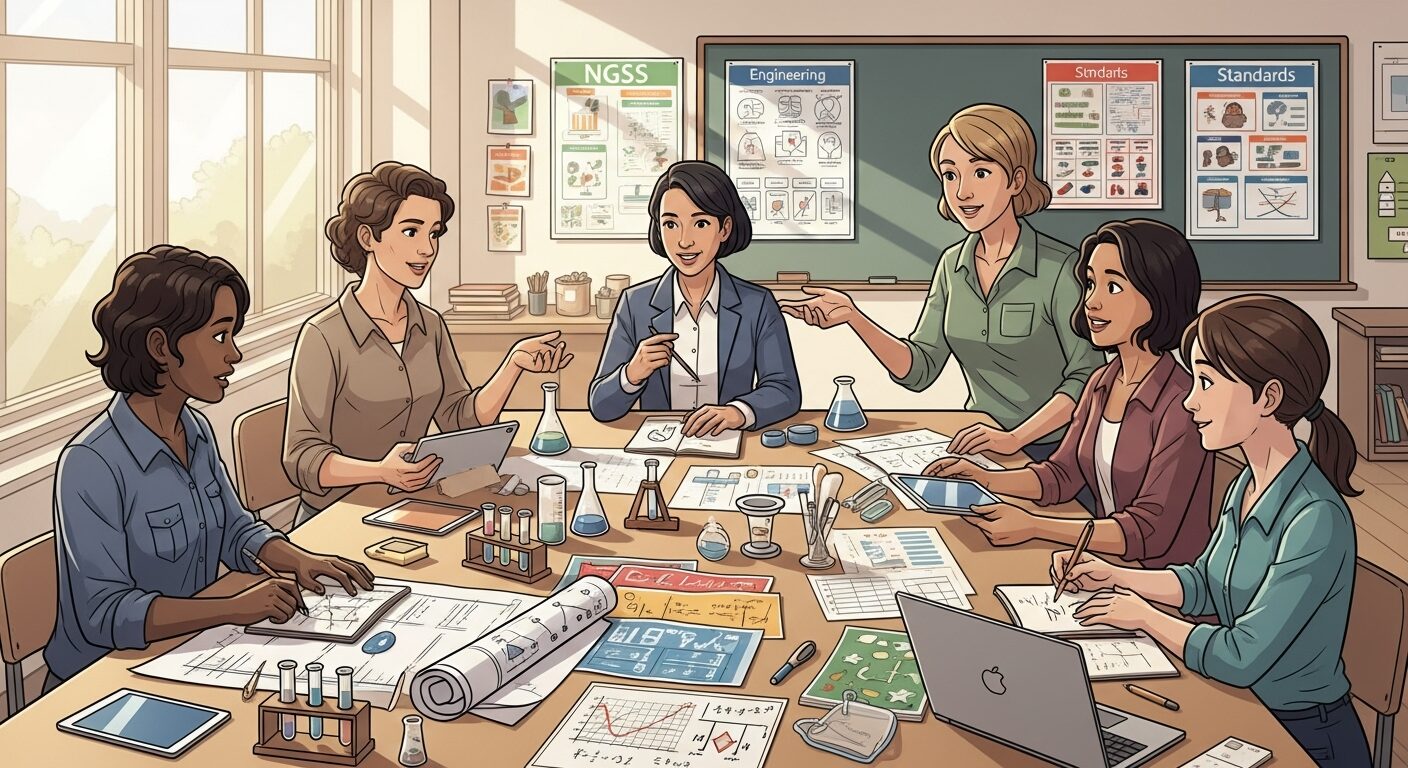
This framework gives K–12 science educators a complete, research-backed system for building coherent, phenomena-driven instruction aligned to the Next Generation Science Standards. Every component — from scope-and-sequence to rubrics — is designed to work together.
Scope & Sequence
Coherent K–12 learning progressions across all NGSS domains.
30 Exemplar Units
Six ready-to-adapt units per grade band with phenomena, PEs, and tasks.
Assessment System
Formative probes, performance tasks, and 3D rubrics for every level.
Teacher Supports
PD topics, misconception guides, family engagement, and timelines.
Printable Templates
Unit planner, lesson plan, assessment blueprint, and pacing calendar.
NGSS Alignment
Full PE mapping by grade band and unit for accountability.
Six Design Principles
These research-based principles guide every aspect of the framework, from unit design to assessment to professional development.
Three-Dimensional Learning
NGSS integrates three dimensions so students learn science the way scientists and engineers actually work — by applying practices, using core ideas, and connecting through crosscutting concepts.
Science & Engineering Practices
- Asking Questions & Defining Problems
- Developing & Using Models
- Planning & Carrying Out Investigations
- Analyzing & Interpreting Data
- Using Mathematics & Computational Thinking
- Constructing Explanations & Designing Solutions
- Engaging in Argument from Evidence
- Obtaining, Evaluating, & Communicating Information
Disciplinary Core Ideas
- Physical Sciences (PS)Matter, forces, energy, waves
- Life Sciences (LS)Organisms, ecosystems, heredity, evolution
- Earth & Space Sciences (ESS)Earth systems, climate, space
- Engineering & Technology (ETS)Design process, optimization
Crosscutting Concepts
- Patterns
- Cause & Effect
- Scale, Proportion, & Quantity
- Systems & System Models
- Energy & Matter
- Structure & Function
- Stability & Change
K–12 Scope and Sequence
How the storyline, disciplinary core ideas, practices, and crosscutting concepts develop across grade bands.
Exploring my world through senses, motion, weather, and living things
PS2, PS4, LS1, ESS2, ESS3, ETS1
Asking Questions, Planning Investigations, Analyzing Data
Patterns, Cause & Effect, Structure & Function
Observing change — light, matter, habitats, landforms, and design
PS1, PS4, LS1, LS2, LS4, ESS2, ETS1
Developing Models, Constructing Explanations, Arguing from Evidence
Patterns, Cause & Effect, Stability & Change
Systems and interactions — forces, energy, ecosystems, Earth processes, and coding
PS2, PS3, PS4, LS1, LS2, LS4, ESS2, ESS3, ETS1
Planning Investigations, Analyzing Data, Using Math/CT, Constructing Explanations
Systems, Energy & Matter, Scale/Proportion, Structure & Function
Mechanisms and models — chemical reactions, fields, thermal systems, cells, plate tectonics, biodiversity
PS1, PS2, PS3, LS1, LS2, ESS1, ESS2, ESS3, ETS1
Developing Models, Analyzing Data, Arguing from Evidence, Using Math/CT
Cause & Effect, Systems, Energy & Matter, Stability & Change
Quantitative reasoning and complex systems — reaction kinetics, momentum, waves, genetics, evolution, climate
PS1, PS2, PS3, PS4, LS1, LS3, LS4, ESS2, ESS3, ETS1
Using Math/CT, Constructing Explanations, Engaging in Argument, Communicating Information
Scale/Proportion, Systems, Energy & Matter, Stability & Change
Learning Progression Maps
How key disciplinary ideas develop in complexity from kindergarten through high school.
Exemplar Unit Bank
30 ready-to-adapt units — six per grade band — each anchored in a compelling phenomenon with aligned performance expectations and assessment tasks.
Instructional Routines
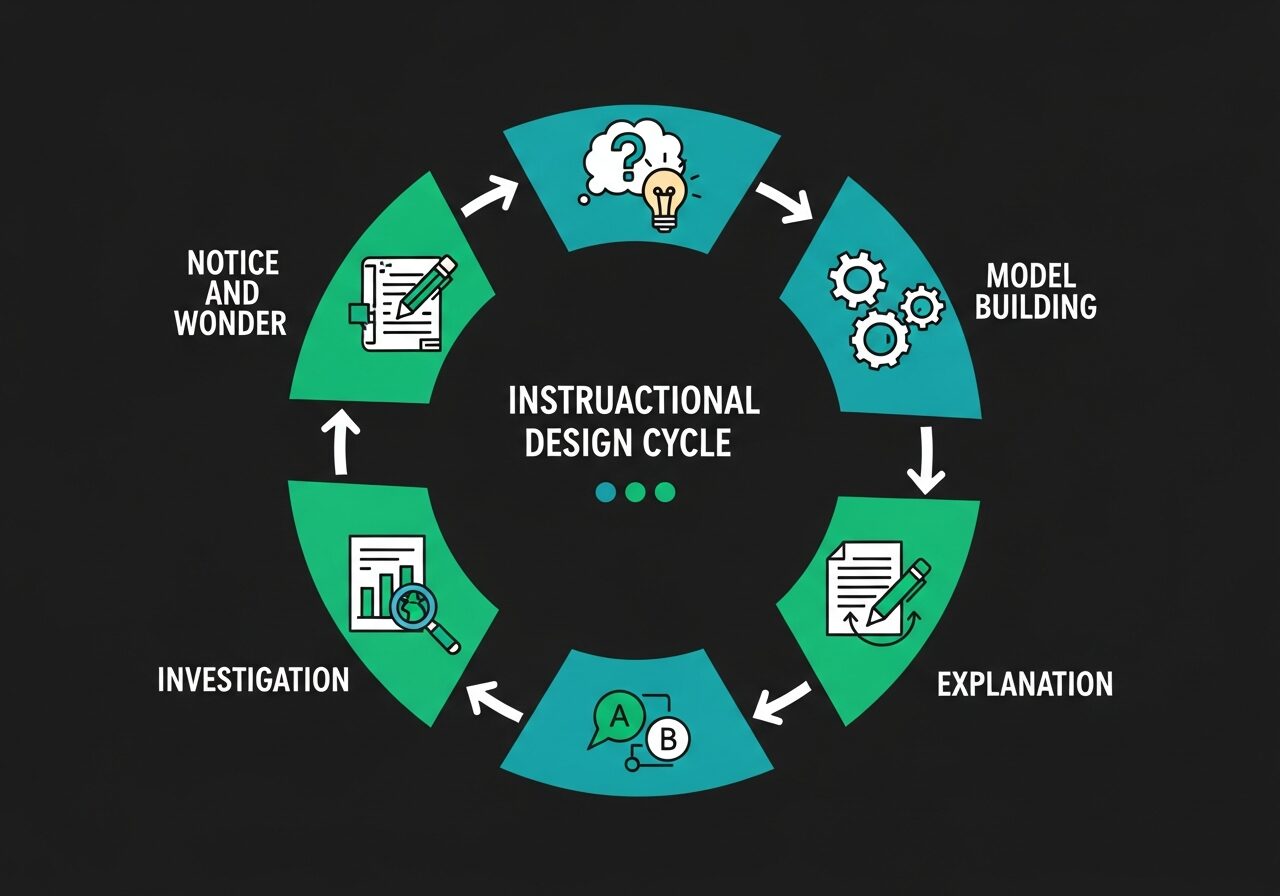
Six repeatable routines that structure student thinking and make three-dimensional learning actionable in every lesson.
Notice–Wonder + Driving Question Board
Students observe a phenomenon and generate questions. The driving question board anchors the unit and is revisited as understanding grows.
Initial Model → Evidence Updates → Final Model
Students draw an initial explanatory model, gather evidence through investigations, revise their model, and present a final version with annotations.
Investigation Planning Template
A structured template guiding students through question, hypothesis, variables, procedure, and data collection plan before beginning an investigation.
Evidence Table + CER
Students organize evidence in a table, then construct a Claim–Evidence–Reasoning argument. CER is practiced regularly to build scientific argumentation skills.
Data Talks
Collaborative graph and table interpretation routines where students describe what they notice, identify patterns, and discuss what questions the data raises.
Engineering Design Loop
Define → Research → Ideate → Prototype → Test → Improve. Students cycle through these steps, documenting decisions and data at each stage.
Assessment System
A balanced assessment architecture that makes student reasoning visible, supports equitable grading, and aligns to three-dimensional learning.
Embedded Formative Probes
Quick checks embedded in lessons that reveal student thinking and inform next instructional moves.
Mid-Unit Checkpoints
Brief assessments at the unit midpoint to gauge progress on key ideas and practices.
End-of-Unit Performance Tasks
Multi-day tasks requiring students to integrate SEPs, DCIs, and CCCs to explain a new phenomenon or solve a design problem.
Common Rubrics
Shared 3D rubrics used across grade-level teams to ensure consistent expectations and calibrated scoring.
Formative Probe Types
Predict–Observe–Explain (POE)
Students predict the outcome of a demonstration, observe what happens, and explain the discrepancy.
Card Sort
Students categorize concepts, terms, or images into groups, revealing how they organize knowledge.
Exit Ticket Sketch
Students draw and label a quick model at the end of class to show their current thinking.
Two-Tier Question
Students answer a multiple-choice item, then explain their reasoning in writing, revealing misconceptions.
Sample 3D Learning Rubric
| Level | SEP | DCI | CCC |
|---|---|---|---|
| Beginning (1) | Follows a procedure given by the teacher | States an observation without connecting to a core idea | Does not reference a crosscutting concept |
| Developing (2) | Plans a partial investigation with guidance | Identifies a relevant core idea but explanation is incomplete | Names a CCC but does not apply it to the phenomenon |
| Proficient (3) | Independently plans and carries out a fair test | Accurately explains the phenomenon using the core idea | Uses a CCC to connect evidence to the explanation |
| Advanced (4) | Designs an investigation that addresses limitations of prior tests | Extends the core idea to a new context or identifies boundary conditions | Integrates multiple CCCs to strengthen the argument |
Equity-Minded Grading Principles
- Grade on demonstration of understanding, not compliance or speed.
- Allow multiple attempts and modalities for showing mastery.
- Separate academic grades from behavior grades.
- Use rubrics that describe what students can do, not what they can't.
- Provide feedback in students' home languages when possible.
Accommodations
English Language Learners
- •Multilingual glossaries and sentence frames
- •Visual models and labeled diagrams
- •Extended time and oral response options
- •Home language allowed for reasoning
IEP Supports
- •Graphic organizers and step-by-step templates
- •Reduced item sets targeting same standards
- •Alternative response modes (oral, visual, tactile)
- •Preferential seating and sensory accommodations
Teacher Supports
Resources and structures to support educators in implementing three-dimensional instruction successfully.
Professional Development Topics
- Facilitating phenomena-driven instruction
- Designing and scoring 3D performance tasks
- Using formative assessment data to adjust instruction
- Supporting multilingual learners in science
- Integrating engineering design across disciplines
- Building coherent storylines across grade bands
- Equity-centered classroom discourse routines
- Collaborative lesson study and peer observation
Family Engagement Strategies
- Send home a one-page "Phenomenon of the Week" flyer with a question families can explore together.
- Host a Family Science Night where students present their unit models and performance tasks.
- Provide multilingual glossaries of key science terms for each unit.
- Share a digital portfolio link so families can see student work and growth over time.
- Offer "STEM at Home" kits with simple materials for extending investigations.
Common Misconceptions & Diagnostic Questions
Implementation Timeline
Year 0 — Foundations
- →Assemble leadership team
- →Conduct needs assessment
- →Select pilot grade bands
- →Begin PD on 3D learning
Year 1 — Pilot
- →Pilot 2–3 units per grade band
- →Collect student work samples
- →Hold monthly PLC meetings
- →Refine units based on evidence
Year 2 — Expand
- →Roll out to remaining grade bands
- →Calibrate rubrics across teams
- →Introduce common assessments
- →Deepen PD on equity and discourse
Year 3+ — Sustain
- →Full implementation all units
- →Annual review and revision cycle
- →Mentor new teachers into the system
- →Share results with community
Printable Templates
Ready-to-use planning tools to support coherent unit and lesson design.
Unit Planner
A structured template for designing coherent, phenomena-driven units with PE alignment, storyline arc, and assessment plan.
Lesson Plan
Daily lesson template with sections for phenomenon connection, SEP focus, student discourse, formative check, and differentiation.
Assessment Blueprint
A planning tool for mapping assessment tasks to 3D learning targets, ensuring balanced coverage of SEPs, DCIs, and CCCs.
Pacing Calendar
Quarterly pacing guide template for sequencing units, assessments, and PD across the school year.
Sources & References
National Research Council (2012). A Framework for K–12 Science Education: Practices, Crosscutting Concepts, and Core Ideas.
National Academies of Sciences (2022). Science and Engineering in Preschool Through Elementary Grades.
Pellegrino, J.W. & Hilton, M.L. (2012). Education for Life and Work: Developing Transferable Knowledge and Skills.
Krajcik, J. & Shin, N. (2022). Project-Based Learning in Science. In R.K. Sawyer (Ed.), Cambridge Handbook of the Learning Sciences.
Lee, O. (2021). Asset-oriented framing of science and engineering practices for multilingual learners. Journal of Research in Science Teaching.
Penuel, W.R. & Reiser, B.J. (2018). Designing NGSS-Aligned Curriculum Materials. National Academy of Education.
Wilkinson STEM Education Foundation (2026). Internal Curriculum Development Documents.