Core Takeaways for Parents
Five principles backed by research to guide your home STEM practice.
Practices, Not Facts
Focus on asking questions, modeling, investigating, and explaining from evidence—not memorizing.
Make It Routine
Short, frequent 5–10 minute moments beat occasional big projects for building confidence.
Growth Mindset
Praise strategies and effort rather than "being smart." Name what they tried and improved.
Equity & Belonging
Use free resources, home language, culturally meaningful problems, and inclusive design.
Purposeful Tech
Use screens for creation, data collection, and simulation. Protect sleep and movement time.
Evidence-Based Foundations
Why STEM at home matters—and what the research says about how families can make the biggest impact.
What STEM Learning Looks Like at Home
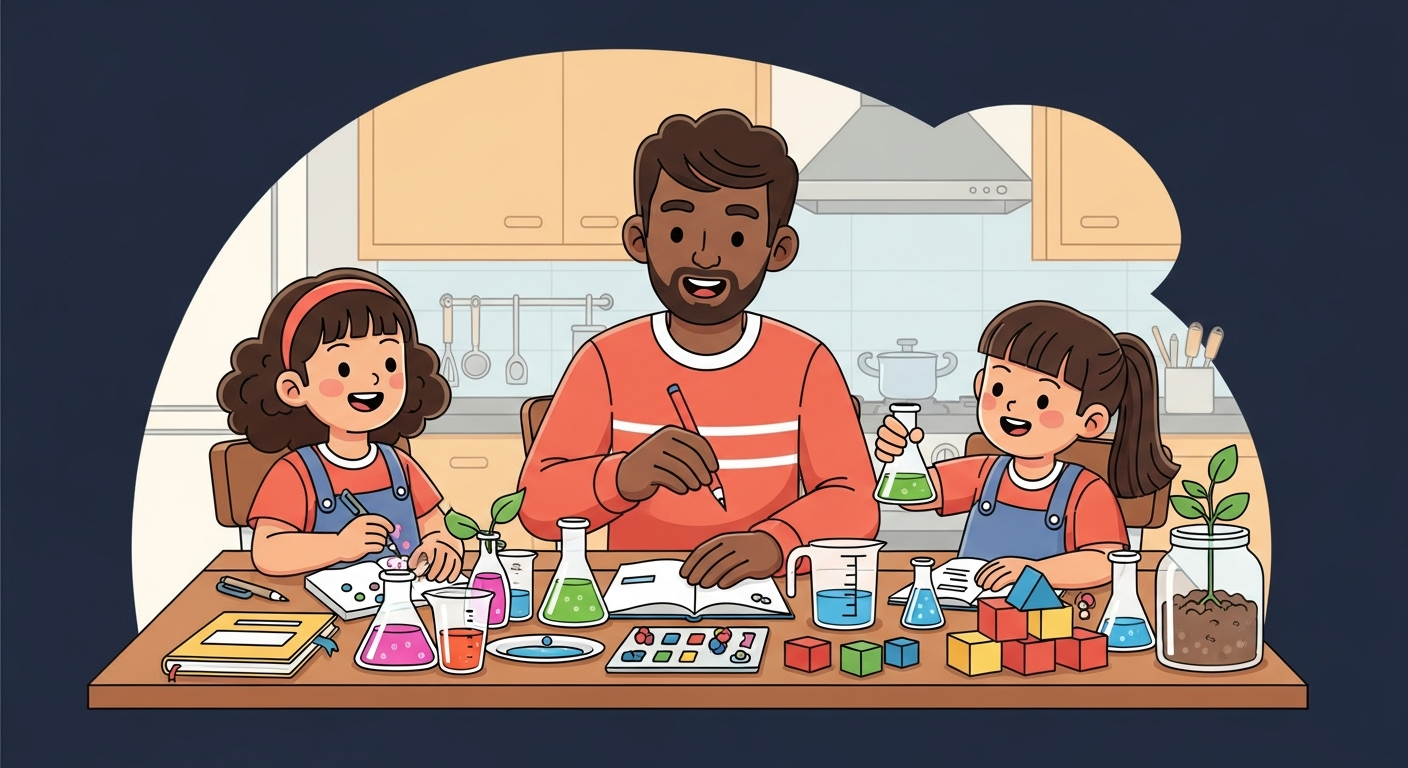
STEM learning at home is the child repeatedly doing what scientists and engineers do—making sense of the world and designing solutions—using everyday materials, talk, and reflection.
A "STEM at home" activity is strong if it includes at least two practices: predict → test → record → explain.
Why the Home Environment Matters
Early math skills are among the strongest predictors of later academic achievement. Home talk is a mechanism, not just a "nice extra"—caregiver number talk predicts children's later number knowledge.
Spatial language variability (words about shape, size, space) predicts children's later spatial thinking and problem solving.
Motivation, Mindset & Identity
Learning outcomes extend beyond facts to include interest, reasoning, and identity—"seeing oneself as someone who can do science." Families who normalize questioning and iteration raise children who approach STEM as doable and meaningful.
Equity & Access for Families
This guide operationalizes equity through low-cost alternatives, culturally meaningful contexts (cooking, community weather, local transportation), multilingual talk, UDL-based differentiation, and leveraging public institutions (libraries, museums, NASA/Smithsonian resources).
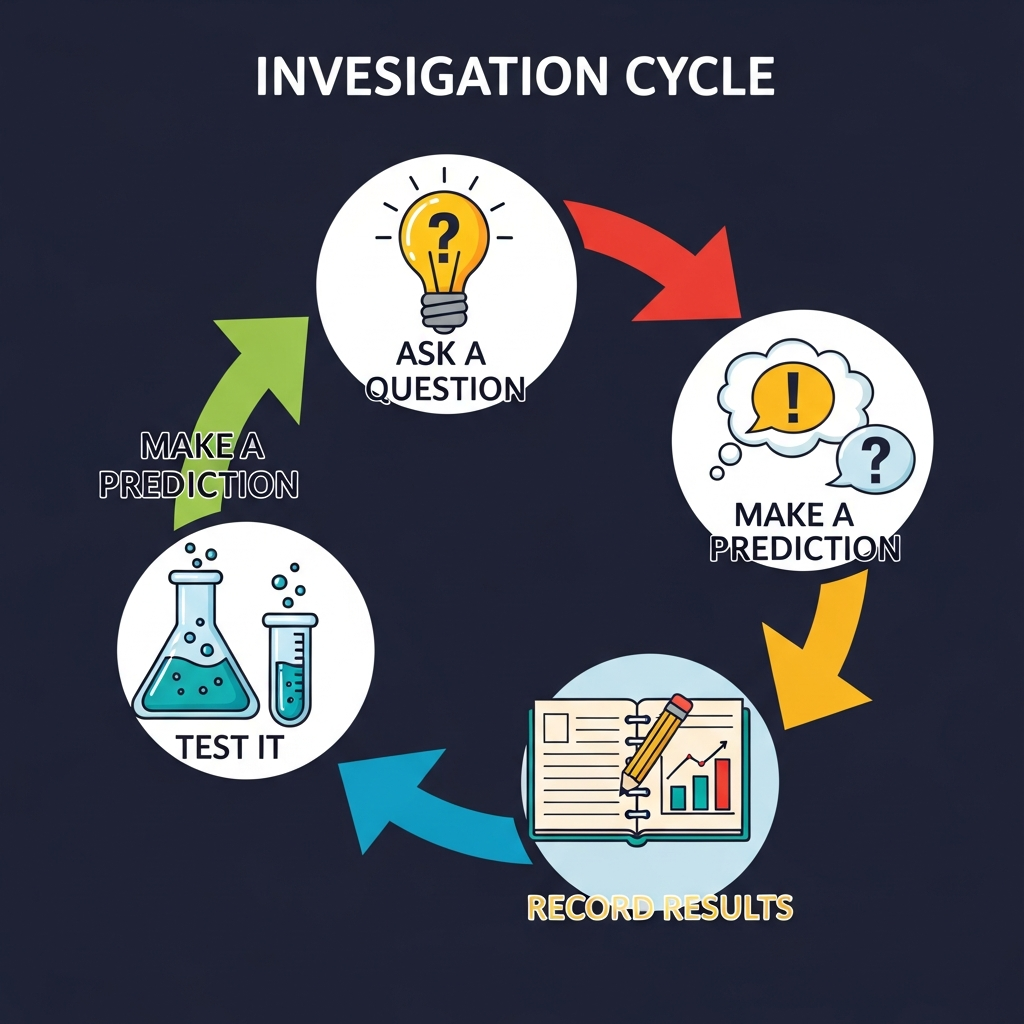
The Investigation Cycle — a reusable anchor for every activity
Family Toolkit
Materials, routines, planning tools, and safety guidance to get started.
Suggested Weekly STEM Rhythm
A repeatable weekly rhythm that balances short routines, two mini-investigations, one longer build, and reflection.
Home STEM Materials Kit
Most activities cost $0–$5 with basic household items.
| Category | Recommended Items | Low-Cost Alternatives |
|---|---|---|
| Measuring & Math | Ruler/tape measure; kitchen measuring cups/spoons; scale; stopwatch/timer | Printable paper ruler; string + marked knots; phone timer; hanger + cups balance scale |
| Observation & Recording | Notebook or binder; pencils/markers; masking tape; sticky notes | Scrap paper; recycled cardboard for clipboards |
| Building & Prototyping | Cardboard; paper; tape; scissors; craft sticks; rubber bands; string | Cereal boxes; paper bags; packaging; old magazines |
| Simple Science Tools | Magnets; flashlight; cups/containers; funnels | Phone flashlight; cut bottle funnels; jars |
| Safety Basics | Safety glasses; band-aids; wipes; adult-only hot glue | "Safety zone" + rules; use white glue or tape instead |
| Optional Tech | Phone camera; free spreadsheet app; simple coding platform | "Unplugged" coding cards; hand-drawn graphs |
High-Impact Micro-Routines (2–5 min each)
Safety & Health Guidance
Safety script: "Ask first, protect eyes, wash hands, clean up, store safely."
Screen-Time Guidance for STEM
Aligned with WHO under-5 guidelines and AAP family media planning tools.
Activity Selection Guide
A simple decision pathway to help your family pick an activity by age, time, and setting.
All 30 Activities at a Glance
Filter by age band to quickly find the right activity for your family.
| Age | Activity | Cost | Time | Difficulty | Skills |
|---|---|---|---|---|---|
| Preschool | Sink-or-Float Lab | $ | 15–20 min | Easy | SEPMATHHABITS |
| Preschool | Ramp & Roll Studio | $ | 20–30 min | Easy | SEPMATHHABITS |
| Preschool | Nature Sort & Pattern Walk | $ | 15–30 min | Easy | SEPMATHHABITS |
| Preschool | Bubble Geometry & Measurement | $ | 15–25 min | Easy | SEPMATHHABITS |
| Preschool | Shadow Watch (Sun & Light) | $ | 10–20 min (+revisit) | Easy | SEPMATHHABITS |
| Preschool | Build-a-Bridge for Toys | $ | 30–45 min | Medium | ENGSEPMATHHABITS |
| K–2 | Magnet Treasure Hunt & Map | $ | 20–30 min | Easy | SEPMATHHABITS |
| K–2 | Paper Helicopter Tests | $ | 20–30 min | Medium | SEPMATHHABITS |
| K–2 | Mini Weather Station | $ | 15–20 min setup + daily | Easy | SEPMATHHABITS |
| K–2 | Seed-to-Sprout Journal | $ | 10 min/day | Easy | SEPMATHHABITS |
| K–2 | Simple Machines: Lever Challenge | $ | 20–30 min | Medium | ENGSEPMATHHABITS |
| K–2 | Unplugged Coding Maze | $ | 15–25 min | Easy | CTSEPHABITS |
| Grades 3–5 | Water Filter Design Challenge | $ | 45–60 min | Medium | ENGSEPMATHHABITS |
| Grades 3–5 | Rubber Band Car Iterations | $ | 45–60 min | Medium | ENGSEPMATHHABITS |
| Grades 3–5 | Circuits: Light-Up Card | $ | 30–45 min | Medium | SEPENGHABITS |
| Grades 3–5 | Egg Drop Data (Small Scale) | $ | 45–60 min | Medium | ENGSEPMATHHABITS |
| Grades 3–5 | Kitchen Fractions Lab | $ | 30–45 min | Easy | MATHSEPHABITS |
| Grades 3–5 | Graph It: Family Data Project | $ | 20–40 min | Easy | MATHSEPCTHABITS |
| Grades 6–8 | Pendulum Period Investigation | $ | 45–60 min | Medium | SEPMATHHABITS |
| Grades 6–8 | DIY pH Indicator + Titration Lite | $ | 30–60 min | Medium | SEPMATHHABITS |
| Grades 6–8 | Spectroscope Build (CD) | $ | 45–60 min | Medium | SEPENGHABITS |
| Grades 6–8 | Phone-Sensor Physics Walk | $ | 30–45 min | Easy–Med | SEPMATHCT |
| Grades 6–8 | Unplugged Encryption & Codes | $ | 30–45 min | Medium | CTHABITS |
| Grades 6–8 | Bottle Rocket Engineering (Safe) | $ | 60–90 min | Hard | ENGSEPMATHHABITS |
| Grades 9–12 | Home Energy Audit & Modeling | $ | 60–120 min | Medium | SEPMATHCTHABITS |
| Grades 9–12 | Statistics in the Wild: Sampling Study | $ | 60–90 min | Medium | SEPMATHHABITS |
| Grades 9–12 | Structural Truss Optimization | $ | 90–120 min | Hard | ENGSEPMATHHABITS |
| Grades 9–12 | Build a Simple Electric Motor | $ | 60–90 min | Medium–Hard | SEPENGHABITS |
| Grades 9–12 | Microbiology at Home: Yeast Respiration | $ | 45–60 min | Medium | SEPMATHHABITS |
| Grades 9–12 | Coding + Data: Analyze Open Weather Data | $ | 60–120 min | Hard | CTMATHSEP |
Age-Band Activity Guides
30 detailed activities organized by age, each with objectives, materials, step-by-step instructions, safety notes, and extensions. Tap any band to expand.
Your Child & Educational Research
What it means if your child's teacher or school participates in a WSEF-hosted research study — and what your rights are.
Your child's learning activities on WSEF may be included in IRB-approved research —
you will always be asked for separate, explicit permission before this happens.
What does it mean if a teacher enrolls a class in a study?
A teacher may choose to participate in an IRB-approved research study hosted on the WSEF platform. This means a university or education research team wants to analyze anonymized learning data (like lesson completion or quiz scores) to understand how students learn STEM. The teacher's participation does not automatically enroll any student. Each parent must separately consent.
The separate parental permission process
If a study is proposed, you will receive a study-specific consent request through your parent account or via email. It will describe the study purpose, what data would be used, and your right to decline. This consent is separate from the platform's standard COPPA consent or Terms of Service — signing those forms never enrolls your child in any research.
Child assent (ages 7+)
For students aged 7 and older, WSEF also requests the child's own assent — an age-appropriate "yes, I want to participate" — separately from parental permission. A child's refusal is respected. Declining to participate never affects a child's access to WSEF's educational content.
What data is used and how it is protected
Research exports contain only pseudonymized learning activity data (scores, time-on-task, concept progress). Your child's name, email, school name, and exact location are never shared with researchers. WSEF holds the mapping between pseudonyms and real identities and never provides it to anyone outside WSEF.
How to opt out
You can decline the consent request when you receive it. If you change your mind after consenting, contact research@wilkinsonstem.org at any time — withdrawal has no effect on your child's platform access.
More information
For the full policy on IRB requirements, participant rights, and data governance, see the Research Governance & Human Subjects Policy.
Parent FAQs
Common questions answered with evidence-based guidance.
Printable Worksheet Templates
Ready-to-use templates for recording observations, data, and designs.
Notice & Wonder Page
K–12 adaptableA one-page prompt with two columns ('Notice' and 'Wonder') and a drawing box. Helps children start from observation before explanation.
Data Table + Bar Graph
Grades 3–8A table for recording trials (what changed, what stayed same, result) and a blank axis for creating a bar graph by hand.
Engineering Design Brief
All agesA structured template: Problem → Constraints → Success criteria → Plan sketch → Test results → What to improve next.
Further Reading & Resources
Trusted sources for deepening your family's STEM practice.
Research & Standards
Early Learning & Family Talk
Safety & Health
Your Family's Rights Under FERPA
If your child's school has adopted our platform as an educational tool, student records on our platform — such as learning progress, quiz scores, and grade-level information — may be "education records" protected under the Family Educational Rights and Privacy Act (FERPA, 20 U.S.C. §1232g). As a parent or guardian, you have important rights:
Right to Inspect Records
Request to view your child's platform records through your school's administrator within 45 days.
Right to Request Corrections
Request corrections to inaccurate records. Contact us at privacy@wilkinsonstem.org.
Consent for Research Disclosure
Your written consent is required before your child's records are shared with researchers, unless a formal research exception and signed Data Use Agreement are in place.
Right to File a Complaint
If you believe your FERPA rights were violated, you may file a complaint with the U.S. Dept. of Education's Family Policy Compliance Office at studentprivacy.ed.gov.
For FERPA questions related to our platform, contact privacy@wilkinsonstem.org. See also our full FERPA notice in our Privacy Policy.