STEM Career Exploration Guide
Help your child explore 15 STEM career paths through 30+ hands-on activities. Research shows early career exposure expands possibilities and builds confidence — before stereotypes narrow the field.
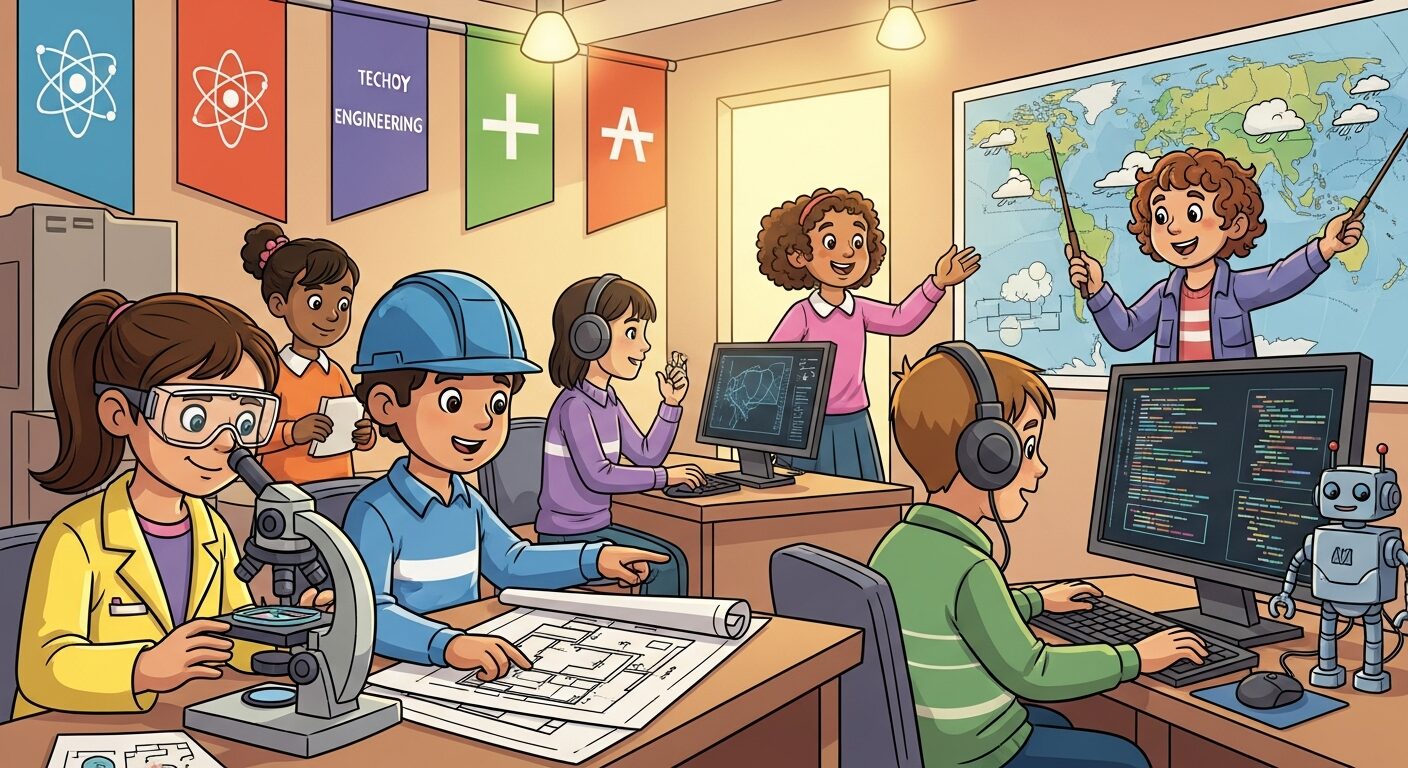
Why Early STEM Career Exposure Works
Career exploration isn't about choosing a job early — it's about expanding the set of "careers I can imagine myself doing."
Aspirations Form Early
Children's occupational aspirations begin forming in preschool and can be progressively narrowed by cultural expectations.
Identity Is Malleable
Identity and motivation develop over time. Repeated positive exposure builds STEM "possible selves" before stereotypes set in.
Home Is Key
Informal learning at home is a powerful environment. Federal STEM strategy highlights family-community-employer collaboration.
Role Models Matter
Research shows role models counter stereotypes and boost girls' math enjoyment, success expectations, and STEM aspirations.
Core Implication for Families
Aim for repeated, varied, low-pressure exposure — short activities + reflective talk + visible role models — so children can try on many STEM "possible selves" before social stereotypes narrow the field.
Home Exploration Framework
A simple repeating cycle that makes career exploration a natural part of family life.
Explore
Try a short activity linked to a career skill.
Reflect
Talk about what was fun, hard, surprising.
Connect
Link the skill to a real job or person.
Repeat
Try another career area next week.
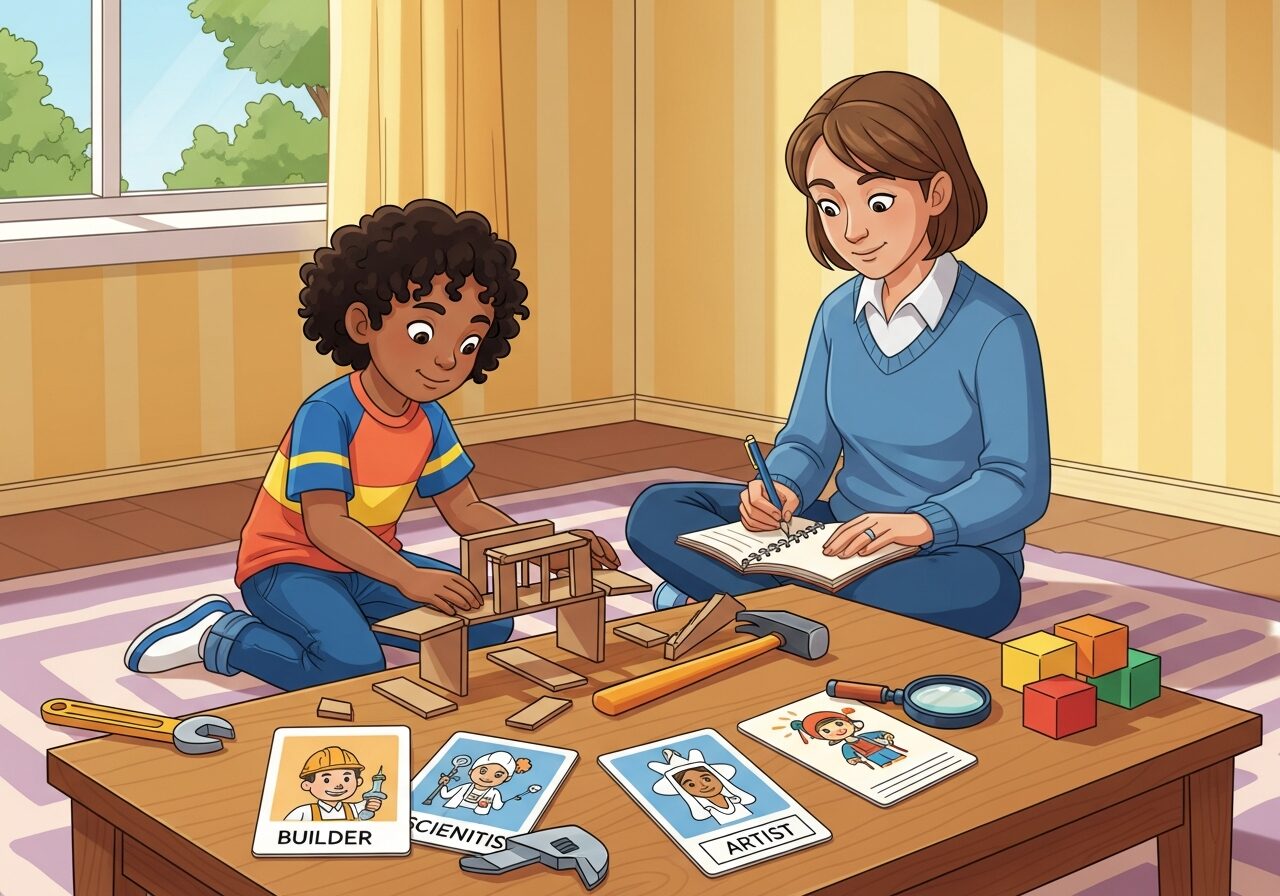
Skills-to-Careers Map
Use this as a "translation layer" between what your child likes to do and careers that use similar skills.
Data Scientist
Data & StatsTurns messy information into answers and recommendations
Skills: Curiosity, logic, math, communication, data visualization
Home mini-task: Do a family mini-survey and make a graph + "recommendation"
Software Developer
ComputingBuilds apps and systems people use
Skills: Problem decomposition, debugging, teamwork
Home mini-task: Paper-prototype an app, run a "user test," revise
Info Security Analyst
Computing / CyberProtects computers and networks from attacks
Skills: Risk thinking, attention to detail, ethics
Home mini-task: Practice encryption (Caesar cipher) and discuss "threat models"
Biomedical Engineer
Engineering / HealthDesigns devices that help the body
Skills: Systems thinking, biology + engineering, iteration
Home mini-task: Build a cardboard "prosthetic" tool and test improvements
Epidemiologist
Health / DataStudies how diseases spread and how to prevent outbreaks
Skills: Data reasoning, patterns, public service
Home mini-task: Run a simple "outbreak" simulation with dice and graph results
Registered Nurse
HealthProvides and coordinates patient care; teaches health skills
Skills: Empathy, observation, communication
Home mini-task: Create a "health routine experiment" (sleep/hydration) and track
Environmental Scientist
Earth / EnvironmentStudies air/water/soil to protect people and nature
Skills: Field observation, measurement, ethics, reporting
Home mini-task: Test a DIY water filter and explain tradeoffs
Geoscientist
EarthStudies rocks, Earth processes, and resources
Skills: Observation, spatial reasoning, modeling
Home mini-task: Model erosion in a tray; propose a safer "city plan"
Meteorologist
Earth / WeatherStudies weather and climate; builds forecasts
Skills: Data, modeling, pattern recognition
Home mini-task: Build a "weather station" log and compare forecasts
Civil Engineer
Engineering / BuiltDesigns bridges, roads, and water systems
Skills: Constraints, safety, measurement
Home mini-task: Bridge-building challenge with load testing and redesign
Mechanical Engineer
Engineering / DesignDesigns and improves machines and systems
Skills: Iteration, testing, mechanics
Home mini-task: Build a rubber-band vehicle and optimize speed vs. control
Industrial Engineer
Design / ManufacturingMakes processes more efficient
Skills: Systems thinking, measurement, improvement cycles
Home mini-task: Run a household "process improvement" study
Industrial Designer
Design / ManufacturingDesigns products that are useful and appealing
Skills: Empathy, sketching, prototyping, user testing
Home mini-task: Redesign a household object with user tests
Aerospace Engineer
Engineering / SpaceDesigns aircraft, spacecraft, and drones
Skills: Physics, modeling, safety, teamwork
Home mini-task: Straw-rocket tests: change one variable and analyze results
Day-in-the-Life Vignettes
Read these aloud to make careers feel real and human. STEM work is collaborative, values-driven, and connected to community needs.
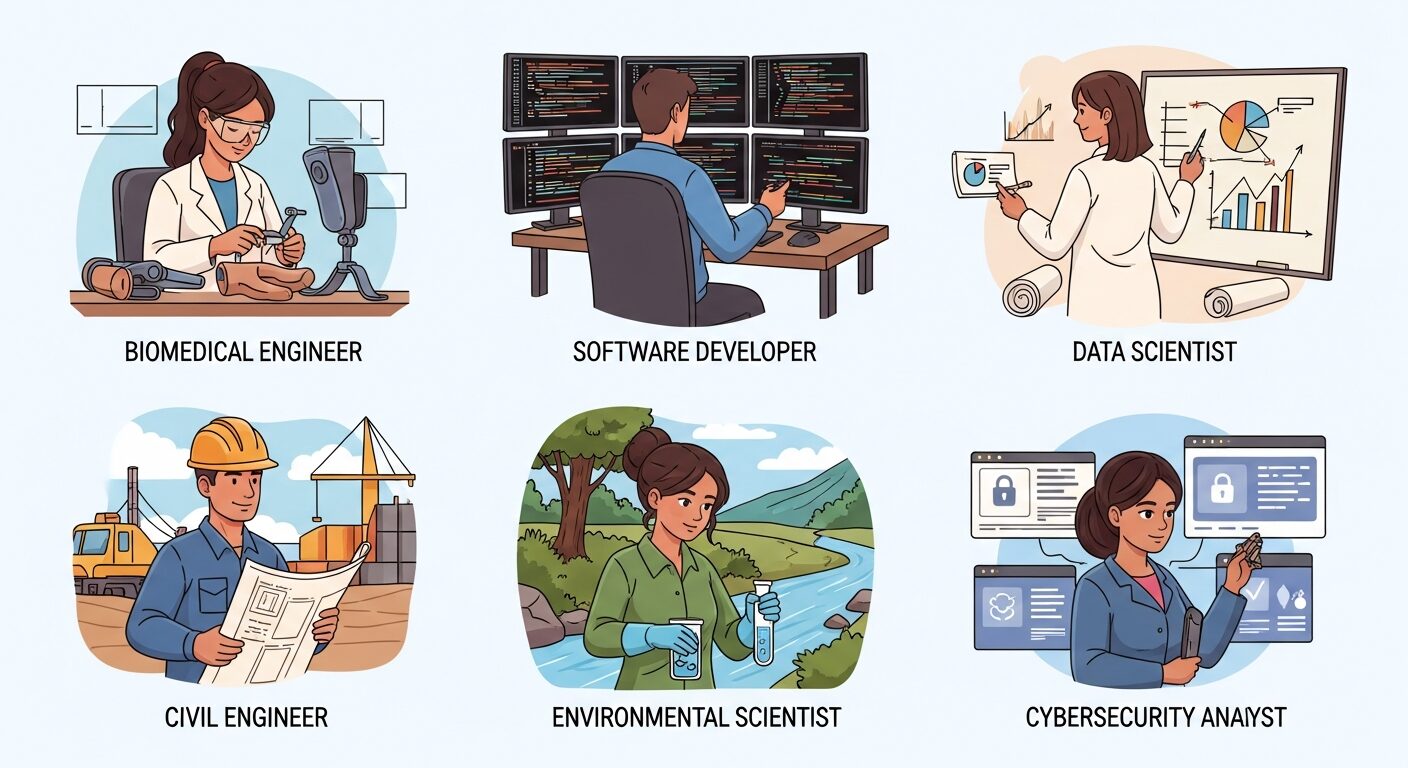
Jayden (they/them)
Biomedical Engineer
Jayden works with doctors and patients to improve a hand brace for kids who have trouble gripping pencils. In the morning, they review feedback: "What hurts? What slips? What feels good?" After lunch, they test three materials for strength and comfort, then write a short report with diagrams and recommendations. They end the day on a video call with a manufacturer to discuss how to make the brace affordable.
Marisol (she/her)
Software Developer & Accessibility Advocate
Marisol builds a reading app. Her team starts by interviewing students and teachers to learn what they need. She draws a simple flowchart of the app's screens, then writes and tests code. She also checks that the app works with screen readers and has clear color contrast so more people can use it.
Malik (he/him)
Information Security Analyst
Malik helps a hospital protect patient data. Each morning he reviews alerts, looking for unusual patterns. He and his colleagues update security tools and train staff on safer habits (like recognizing phishing). When something goes wrong, he helps respond quickly to limit damage.
Anika (she/her)
Environmental Scientist
Anika studies water quality near a community park. She collects samples, records measurements, and compares results to safety guidelines. Then she meets with local leaders to explain findings in plain language and recommend actions.
Kaimana (he/him)
Meteorologist-in-Training
Kaimana uses data from instruments and computer models to predict rain that may cause flooding. Some days he helps improve sensors that collect better data. He shares forecasts with emergency managers and the public, because clear communication saves lives.
Elena (she/her)
Civil Engineer
Elena designs a safer intersection near a school. She studies traffic patterns, measures sight lines, and checks accessibility for wheelchairs and strollers. She works with city staff and construction teams to ensure the design matches safety rules and budget.
Sam (they/he)
Epidemiologist
Sam investigates why more people in a town are getting sick. He looks for patterns by age, neighborhood, and timing, then tests explanations. He shares recommendations — like targeted vaccination clinics or ventilation improvements — based on evidence.
Mini Informational Interview Sheet
Use this template when your child meets a STEM professional — at school, a community event, or a family gathering.
Career-Linked Activity Library
30+ hands-on activities organized by age band. Each connects everyday skills to real STEM careers.
Equity, Access & Inclusion
Every child deserves to see themselves in STEM careers. Here's how to make exploration inclusive.
Low-Cost Materials
All activities use common household items. Substitutions are listed. Libraries and community centers often provide free supplies.
Multilingual Support
Use your home language for discussions. Key vocabulary can be practiced in multiple languages. Bilingualism is an asset in STEM careers.
Neurodiversity Friendly
Activities include differentiation notes: sensory accommodations, visual step cards, partner options, and flexible pacing.
Counter Stereotypes
Vignettes feature diverse role models across gender, ethnicity, and ability. Emphasize effort over "natural talent" to build growth mindset.
Virtual Resources
Free tools like Scratch, Code.org, NASA STEM, and Smithsonian STEAM resources extend learning for all families.
Family-Centered
Activities are designed so any caring adult can facilitate — no STEM background required. Focus on curiosity, not correctness.
Four-Week Career Cluster Rotation
A sample monthly plan that cycles through career clusters. Pick the activity matching your child's age band each week.
Vet Checkup (Pre-K), Germ Spread Sim (K-2), Prosthetic Helper (3-5), Outbreak Sim (6-8), Enzyme Lab (9-12)
Coding Parade (Pre-K), Paper App Designer (K-2), Scratch Game (3-5), Cipher Lab (6-8), Data Story (9-12)
Weather Reporter (Pre-K), Water Filter (K-2), Erosion Model (3-5), Climate Bottle (6-8), Energy Audit (9-12)
Bridge Builder (Pre-K), Pinwheel Test (K-2), Assembly Line (3-5), Straw Rockets (6-8), Electric Motor (9-12)
Comparison Across Age Bands
See how activities scale in complexity, time, and focus as children grow.
| Age Band | Ages | Focus | Key Skills | Format | Duration | Complexity |
|---|---|---|---|---|---|---|
| Preschool | 3–5 | Career awareness through play | Matching, observing, pretending, sorting | Dress-up, sorting, building | 10–25 min | Low |
| K–2 | 5–8 | Connecting school skills to jobs | Classifying, measuring, modeling, recording | Field notes, filters, simulations | 15–40 min | Low–Medium |
| 3–5 | 8–11 | Iterative design and data | Engineering cycle, data collection, debugging | Build & test, surveys, coding | 45–90 min | Medium |
| 6–8 | 11–14 | Ethics, identity, experiments | Experimental design, encryption, user research | Simulations, labs, studies | 45–75 min | Medium–High |
| 9–12 | 14–18 | Real data, portfolios, claims | Analysis, documentation, empathy, modeling | Labs, audits, redesign, data stories | 60–180 min | High |
Sources & Further Reading
This guide draws on peer-reviewed research, federal STEM strategy, and official occupational data.
Gottfredson, L. S. — Circumscription and compromise: A developmental theory of occupational aspirations.
U.S. Dept. of Education — career awareness guidance: elementary school is "not too early" to help children discover many kinds of jobs.
Federal Strategic Plan for Advancing STEM Education (Charting a Course for Success, 2018).
View SourceNational Academies — How People Learn II: identity, motivation, and the learning environment.
NSF — Advancing Informal STEM Learning (AISL) program.
View SourceFrontiers in Psychology — Female STEM role-model intervention study.
View SourceNational Academies — Mentoring report highlights.
View SourceBLS Occupational Outlook Handbook & O*NET — official career information systems.
View SourceNASA STEM Engagement Resources.
View SourceSmithsonian STEAM Learning Resources.
View SourceCode.org — Free coding education.
View SourceScience Buddies — Career discovery.
View Source